Why Large File Workflows Break and How Media Teams Are Anchoring Control
In case you missed us, the Egnyte team was at NAB 2026 in Las Vegas. During a Tech Theater session, we dove deep into the mechanics of modern media workflows and why the traditional model of collaboration is reaching a breaking point.
The conclusion? The industry has a problem that goes far deeper than just "large files are hard to move."
The Core Problem: Working-Copy Multiplication
In modern post-production and creative workflows, the "file" itself isn't the standalone issue. As file sizes balloon due to higher resolutions, uncompressed formats, and complex project structures, the traditional model of moving entire assets creates significant fragmentation across teams.
To keep work moving swiftly and bypass network latency, media teams inevitably do what they must to stay responsive: They create extra working copies.
Instead of a single file passing seamlessly through a production pipeline, it multiplies. Every handoff to a new collaborator, department, or external agency generates a new local iteration.
The Cost of Fractured Control
Teams don't duplicate files out of carelessness—they do it to maintain active desktop performance and avoid editing lag. However, this survival tactic breaks the project's operational integrity in four critical ways:
- Fractured permissions: Access control and security policies don’t automatically follow a duplicate file. Permissions must be manually re-applied at every single copy boundary, creating immediate compliance gaps.
- Severed version history: The moment a file is copied locally, its continuity restarts. The new working file holds no "memory" of past iterations, leading to confusion over which edit is truly the latest.
- Lost project context: Critical asset relationships, metadata tags, and internal application links are frequently broken or stripped away in transit.
- Blind audit trails: IT and security visibility ends the moment a file leaves the governed space. Tracking exactly who touched, edited, or downloaded the asset across handoffs becomes impossible.
Throwing faster transfer tools or accelerated sync mechanisms at the problem doesn't change this underlying breakdown—it just allows teams to duplicate fragmented files faster.
A Real-World View: The Lifecycle of a Commercial Campaign
To understand how quickly this control disintegrates, consider a typical high-velocity commercial production or multi-asset marketing campaign:
[1. Editorial/Offline Edit] ───> [2. Agency Review] ───> [3. Brand & Legal Sign-off] ───> [4. Localization] ───> [5. Final Delivery Packages]
- Editorial: The editor works locally out of necessity to ensure real-time playback performance.
- Agency review: To share progress, the editor exports a massive project copy or temporary render and pushes it to an external transfer service for the agency. Control splits.
- Brand and legal: The agency makes notes, creates another copy, and forwards it to corporate legal and brand teams for compliance validation. Version history is now scattered across three different silos.
- Localization: Once approved, the master file is copied again and sent to a localization house to spin up regional variants, audio dubs, and distinct aspect ratios.
- Delivery: By the time the final campaign packages reach distribution channels, the original file has multiplied into dozens of unmanaged working versions, leaving a massive security and organizational headache in its wake.
The Cleaner Way Forward: Anchoring to the Egnyte Source of Truth
The solution isn't about eliminating copies entirely. Modern media workflows will always fundamentally require operational variants—including low-res proxies, review exports, localization versions, VFX pulls, and final delivery packages.
Rather, the goal is to eliminate unnecessary working-copy duplication born strictly out of performance limitations.
That’s where Adaptive Block Caching (ABC), built natively into the Egnyte Desktop App, fundamentally shifts the paradigm.
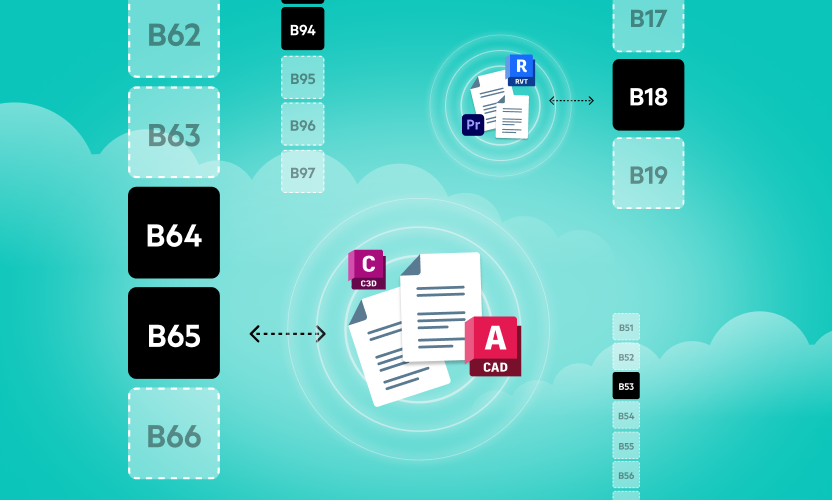
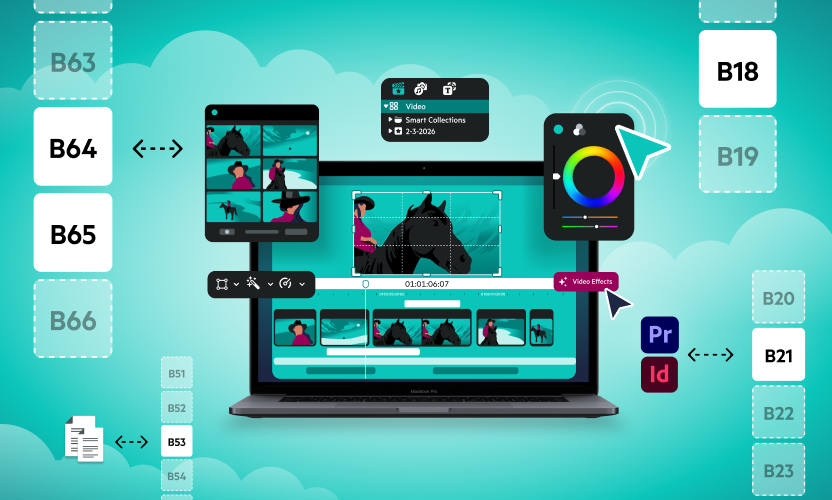
ABC alters how the desktop app interacts with the cloud. Instead of forcing a full file download or requiring an editor to drag a file out to a local drive to begin work, ABC streams and caches individual data blocks directly on the workstation drive on-demand.
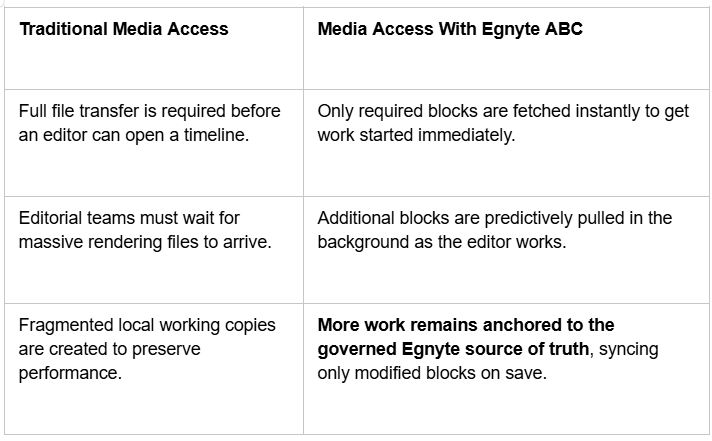
One Centralized State Across the Lifecycle
By removing the performance constraints that force creative teams into local workarounds, the entire campaign workflow can be consolidated. Whether it’s editorial, audio, graphics, or final review, everyone works securely against the exact same system of record.
By keeping creative work anchored to Egnyte, media organizations can finally maintain persistent governance, absolute version clarity, and full audit visibility from initial ideation straight through to final distribution.