The Evolution of AI in Financial Services
Opera and artificial intelligence may not seem like natural companions, but they share one important truth: The best performances are revealed over time. Early scenes set the stage, introduce the themes, and create a sense of anticipation. The audience leans in, waiting for the big moments still to come.
AI in financial services has followed the same structure. What began decades ago as quiet, behind-the-scenes automation has evolved into today’s generative era, where AI for financial services is no longer just background support but a star performer. And just like in opera, every act matters because the brilliance of the finale depends on the careful setup that came before.
At a Glance: The Evolution of AI in Financial Services
Before we go into the journey of AI in financial services, transitioning from back-office automation to front-office strategic priority, lets get a quick overview of where we are going.
- Evolution of AI: From the rule-based 1970s automation and 2000s machine learning for fraud detection to today’s context-aware compliance systems.
- The Generative Era: How AI search, automated policy extraction, and research synthesis are transforming productivity for advisors and insurers.
- The Governance Requirement: Ensuring that AI deployment remains secure, auditable, and compliant to avoid hallucinations and regulatory risk.
- The Egnyte Advantage: Centralizing content to provide the collaboration, intelligence, and governance needed for AI workflows.
Bottom line: Innovation without governance is noise; with the right conductor (Egnyte), it's a masterpiece.
Act I: Setting the Stage With Automation
In the 1970s and ‘80s, AI in banking and financial services was functional, not flashy. Rule-based systems reconciled transactions and performed forecasts. These opening scenes were necessary for the story to move forward, but not the moments that left anyone breathless or leaping to their feet for a standing ovation.
Still, the foundation mattered. These early systems taught financial firms the value of consistency and scale. Without that groundwork, the later acts wouldn’t have the same power or perhaps even exist at all.
Act II: Fraud Detection Finds Its Voice
By the 2000s, machine learning in financial services took center stage in fraud detection. Suddenly, models could adapt and learn, spotting anomalies buried deep in transactions or insurance claims that people or rule-based tools often missed.
This was AI’s first showstopping moment.
Firms saved billions and gained confidence that machines could keep pace with the ever-accelerating tempo of bad actors. Fraud wasn’t eliminated, but the AI’s performance changed, becoming faster and more dynamic than the rule-based opening act that preceded it.
Intermission
You may be thinking to yourself, “Why all this opera talk?” It’s one of my passions outside the office. And honestly, it fits.
Opera rarely gives you the showstopper in the first five minutes. You have to sit through the setup, the rising tension, and sometimes some painfully bad moments to get to the good stuff. But when the payoff comes, it soars. AI in financial services is much the same: The early acts mattered, but we’re just now arriving at the most exciting parts, so finish your intermission drink and get back to your seat.
Act III: Compliance Brings the Tension
The 2010s brought heightened challenges: more regulations. Following the 2008 crisis, firms faced demands to monitor vast amounts of communications data. Early keyword-based tools couldn’t distinguish between “I guarantee you’ll have a great time if you give opera a chance” and “I guarantee I can get you 17% return next quarter.” It flagged everything, creating a cacophony of false alerts. Compliance officers were drowning.
AI added much-needed nuance. Context-aware systems could separate harmless chatter from actual risk, reducing noise while improving detection. Compliance didn’t become effortless, but it became more precise and sustainable. This was the balancing act that kept the performance on track.
Act IV: The Generative Crescendo
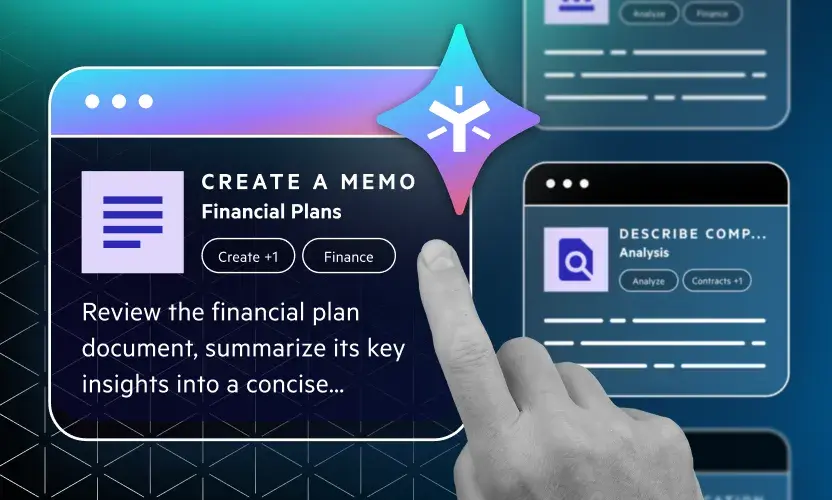
Then came 2022, and with it, the dramatic entrance of generative AI in financial services. This was the high note, the climactic moment. Suddenly, AI wasn’t backstage or in the orchestra pit—it was onstage, dazzling the audience by transforming how people work:
- AI search gave advisors instant access to insights across hundreds of thousands of documents.
- Insurers began extracting clauses from policy documents with a single query.
- Investment firms tapped vast research archives in seconds.
Generative AI didn’t replace earlier acts—it built on them. The finale’s brilliance depended on the themes set in motion decades earlier.
The Refrain: Opportunity Always Demands Governance
Opera thrives on structure—without a score, the music collapses into chaos. AI in financial services is no different. Every leap forward has required governance to keep the performance in tune.
Fraud detection demanded good data. Compliance demanded auditability. Generative AI demands secure, governed environments where hallucinations and regulatory risk don’t derail the performance.
That’s where Egnyte enters, not as a soloist, but as the conductor ensuring the entire ensemble stays in harmony.
Egnyte: Conducting AI’s Future in Financial Services
At Egnyte, we see the same three pillars echoing through every act of AI’s evolution:
- Collaboration: AI can only sing if it has access to the right content. Egnyte ensures financial firms’ content, including CIMs, client files, and contracts, is centralized, accessible, and ready for artificial intelligence in financial services.
- Intelligence: From AI search and copilots to agents and workflows, Egnyte equips firms to uncover insights at ever-faster tempos without sacrificing precision.
- Governance: Governance isn’t an afterthought. With Egnyte, it’s written into the score. Data stays in a secure environment, every interaction is auditable, and compliance is built in by design.
The Finale
AI’s story in financial services is far from finished. The next acts will include document evaluators, complete workflow automation, and compliance copilots that adapt as regulations do.
But two things are clear: Innovation without governance is noise. Innovation with governance is music.
With Egnyte, financial institutions can perform the whole opera of AI: smarter, safer, and seamlessly orchestrated, saving the very best for the acts still to come.
Want to learn more about how financial services firms are implementing AI into their practices? Read our Ultimate Guide to AI in Financial Services.